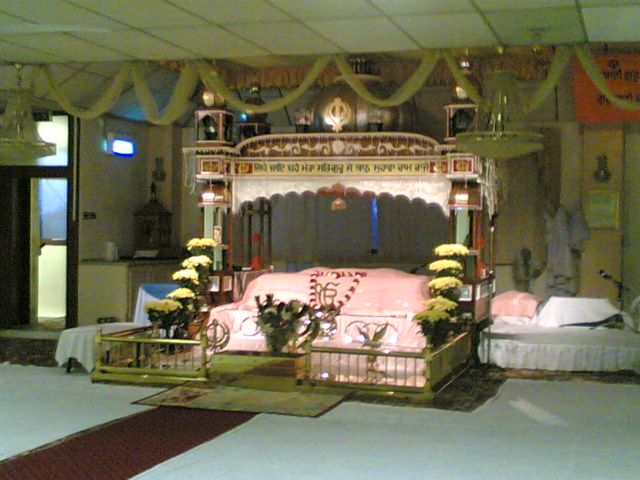
a man limps into the main hall of the Fremont Gurdwara. his walk is that peculiar shuffle of someone who has had both legs broken and learned to walk again. his beard is full and black, eyes strong, head high. he is not old enough to be suffering so much pain from the simple act of walking. when he bows his matha tek, his feet tell a horror story of pain. blackened stripes scar the soles of his feet. the hallmark of the Punjab Police- red hot iron bars used to beat the soles... as if by beating the sole they can break the soul.
he walks to the side of the Palki Sahib, stopping at the side to gently smooth the pure white sheet and again bow his respect to his Guru. at the back, he touches his head to the ground and straightens the small rug, then on to the next side to smooth and bow.
slowly, he walks to the large container of water at the far side of the hall, sees that it is half empty, and hoists it to his shoulder. then ever more slowly, he limps out of the room. after a while, he reappears, a full jug on his shoulder, and places it back on it's stand. a heavy job for a man without his pain, yet that smile never leaves his face.
once again he bows his respect, then sits for a bit in meditation.
when he rises, it's slowly, bending from the waist rather than the knees. he never quite bends his knees, perhaps they no longer function as they should. he bows one last time, then walks slowly out of the hall. head high, eyes strong.
this Gurdwara, this town, this country has many such men and women. broken in walk but not in spirit. devoted, kind, silent and strong. they came alone or in small groups, most of them in the last 25 years. They left homes, jobs, friends and often families behind. they gently and quietly continue their seva, their devotion never fails. their scars are both visible and invisible. you can see them if you look, if you know the horrors they survived. maybe you just think he is old or perhaps had a bad accident. but this was no accident.
when you see him, gently bending to smooth the sheet under the palki sahib, ask yourself one thing. is this what a terrorist looks like?
salok kabeer || Salok, Kabeer:
gagan dhamaamaa baajiou pariou neesaanai ghaao || The battle-drum beats in the sky of the mind; aim is taken, and the wound is inflicted.
khaeth j maa(n)ddiou sooramaa ab joojhan ko dhaao ||1|| The spiritual warriors enter the field of battle; now is the time to fight! ||1||
sooraa so pehichaaneeai j larai dheen kae haeth || He alone is known as a spiritual hero, who fights in defense of religion.
purajaa purajaa katt marai kabehoo n shhaaddai khaeth ||2||2|| He may be cut apart, piece by piece, but he never leaves the field of battle. ||2||2||




7 comments:
I don't know what to say to this one. We can only imagine what these GurSikhs have faced and suffered.
~ Mehtab Singh
mehtab veer ji
Waheguru Ji Ka Khalsa, Waheguru Ji Ki Fateh!
I hate to say this but I am not sure how can gursikhs be treated as terrorists?
Recently, I came to know that in Gurdaspur, young amritdhari sikhs from KAC ( Khalsa Action Committee) were tortured/killed/arrested on the pretext of Baba Ram Rahim saadh? One of the young guy ( who is at present under arrest) said that I was never been arrested by punjab police, when I use to do drugs but now with Gurus Kirpa, I am walking on the path shown by Guru but Indian govt cannot digest this and they are torturing/killing and arresting us.
This is a recent news, KAC has been instrumental in unity of various non-political sikh organisations. They are doing commendable job in spreading Gurmat all over the punjab. They are helping youth to get rid of drugs. But I think, Indian govt has some other plans, they cannot see sikh youth drug free and gursikh. Again, they want to kill very sikhi spirit which spreads message of equality and Gurmat.
Vaheguru ji ka khalsa!
Vaheguru ji ki fateh!!
Oh, dear! This one shames me.
Two years after my stroke, I can still not bow a decent matha tek and need help getting back up. I must practice harder at home, become stronger and more agile. And quit using this as one of my excuses - there are others - to avoid the gurdwara.
'When your enemy has you flat on your back, his knife at your throat, his gun at you temple' - and his red-hot iron on your sole - 'and his boot on your face,' you say, 'Ha, you can kill me, but you can't defeat me!.' That is chardi kala. That is what it means to be a Sikh!'
And that is the spirit that sustains us in these horrible circumstances.
And Guru Gobind Singh Ji Maharaj really does look after his children.
Chardi kala!
One of my daughters-in-law sent this to me, and I hope it's appropriate to share it here:
Some years ago, on a hot summer day, a little boy
decided to go for a swim in the old swimming hole that was behind his
house. In a hurry to dive into the cool water, he ran out the back
door, leaving behind shoes, socks, and shirt as he went.
He flew into the water, not realising that as he swam toward the
middle of the lake, an crocodile was swimming toward the shore.
In the house, his mother was looking out the window. She saw the two
as they got closer and closer together. In utter fear, she ran toward
the water, yelling to her son as loudly as she could.
Hearing her voice, the little boy became alarmed, and made a U-turn
to swim to his mother. It was too late. Just as he reached her, the
crocodile reached him. From the dock, the mother grabbed her little
boy by the arms, just as the crocodile snatched his legs. That began
a very incredible tug-of-war between the two.
The crocodile was much stronger than the mother, but the mother was
much too passionate to let go.
A farmer happened to drive by, heard her screams, raced from his
truck, took aim, and shot the crocodile. Remarkably, after weeks and
weeks in the hospital, the little boy Survived. His legs were
extremely scarred by the vicious attack of the animal. On his arms,
there were deep scratches where his mother's fingernails dug into his
flesh, in her effort to hang on to the son she loved.
The newspaper reporter, who interviewed the boy after the trauma,
asked the boy if he would show him his scars.
The boy lifted his pant legs. Then, with obvious pride, he said to
the reporter, 'But look at my arms. I have great scars on my arms,
too. I have them because my Mom wouldn't let go.'
You and I can identify with that little boy.
We have scars, too. No, not from an crocodile, but the scars of a
painful past. Some of those scars are unsightly, and have caused us
deep regret. But, some wounds, my friend, are because God has refused
to let go. In the midst of your struggle, S/He's been right there,
holding on to you.
Gurbani teaches that God loves you.
You are a child of God. S/He wants to protect you, and provide for
you in every way. But, sometimes, we foolishly wade into dangerous
situations, not knowing what lies ahead. The swimming hole of life -
the terrifying world ocean - is filled with peril ~ and we forget
that anything can - and does - happen. That is when the tug-of-war
begins.
If you have the scars of His/Her love on your arms, be very, very
grateful. S/He will not ever let you go.
Never judge other persons' scars, because you don't know how they got them.
(A successful person is one who can lay a firm foundation with the
bricks that others throw at him or her.)
Chardi kala!
Mai Harinder Kaur
Beautiful! thanks so much for sharing that, didi! :)
Post a Comment